"Riya" and the 5-Lakh Screenshot: Anatomy of the $200Cr Romance Scam That Almost Got Me
I almost lost $500 today. Actually, that’s a lie. I almost lost everything.
It didn't start with a shady email or a frantic phone call from the "IRS." It started on RandoChat, just like a hundred other casual conversations. But within ten days, I was one click away from handing my savings to an organized criminal syndicate.
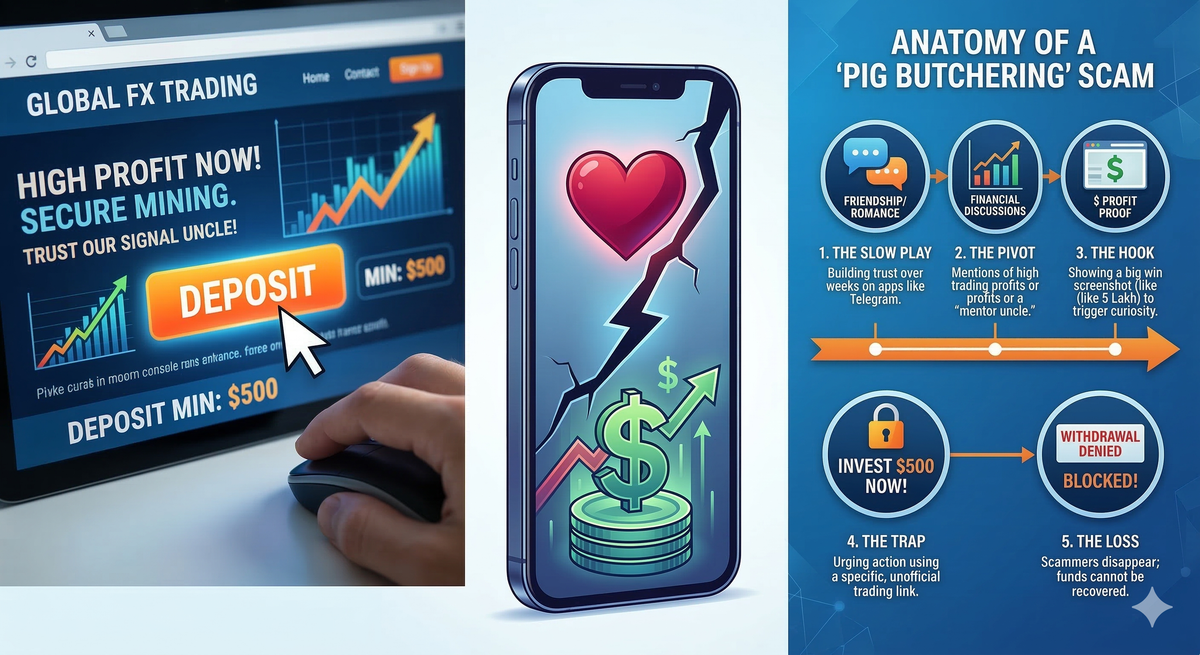
If you are using chat apps, particularly RandoChat or Telegram, you need to read this. This is the exact, step-by-step breakdown of how a sophisticated "Pig Butchering" scam works—and how I almost fell for it.
The Slow Play: Meet "Riya"
The profile seemed normal. Her name was Riya. We matched, and the conversation was effortless. Unlike the usual bots, she was generous, engaged, and genuinely interesting. She told me she was based in Vizag, managing a family business that boasted profits between 100-200 crore INR.
It was a perfect profile: successful but vulnerable. She mentioned her father had recently passed away and her brother was working abroad, leaving her alone to manage this massive enterprise. She painted a picture of a successful businesswoman who was also lonely and looking for a connection.
The Pivot: Building the "Trust" Brand
A few days in, she suggested we move the chat to Telegram. In hindsight, this was the first critical step. Scammers prefer Telegram because it’s harder to trace, allows for self-destructing messages, and keeps their real phone numbers hidden.
Over the next ten days, the focus was entirely on "us." We spoke daily. She hinted at a future together, perhaps even marriage. She was grooming me, but I thought she was falling for me.
The topic of finance was treated delicately. She mentioned she did currency trading, but it was just a facet of her successful life—not a sales pitch. Yet.
Then came the scheduled "Proof of Life." She casually told me that she had a business meeting scheduled in my city in three months. "We will meet then," she said. It gave the virtual relationship a physical anchor, a deadline to look forward to, making everything feel infinitely more real.
The Hook: The "5 Lakh" Screenshot
The trap was sprung gently. During one of our usual trust-building chats, she shared a screenshot. It was a trading statement showing a profit of 5 Lakh rupees. She told me she was "super proud" of this win.
The genius of this move is its subtlety. It wasn't "You should do this." It was "Look what I achieved." It triggers curiosity and envy. The topic of trading stopped almost immediately after that, returning to our "relationship." The seeds of the scam were planted, but they hadn't yet tried to harvest.
The Trap: "My Uncle Has a Tip"
Ten days after that initial chat on RandoChat, the tone changed. Riya messaged me, excited. "The market is doing good," she said. She told me her "uncle" (the classic "expert mentor" figure in these scams) had given her an exclusive tip-off.
"We can make profit together," she said.
This was the first time she asked for money. But it was a small, "safe" amount: just $500. She framed it as a shared adventure, a way for us to build something together.
The Breaking Point: "Not Zerodha"
When she asked me to invest, my natural skepticism kicked in. I’ve traded before. I asked if I should use standard Indian apps like Zerodha.
She resisted immediately. "Those don't have the dollar ($) exchange," she argued. "They are mostly INR." While technically true for certain international forex pairs, her alternative was terrifying.
She told me she would provide me with a specific link to create an account. "15 minutes are enough to create an account and start trading," she pushed. The urgency was a new, alarming sensation. The casual friendship was gone; now it was a high-pressure sales tactic.
The Save: Trust, but Verify
I didn't click the link. Instead, I opened a new tab and described the entire situation, from the Vizag business owner to the dollar-based trading link, to an AI assistant (Gemini).
The diagnosis was instant, cold, and devastating: Pig Butchering.
The terminology refers to "fattening" the victim (the pig) with emotional connections and romance before "slaughtering" them for their money. Every single point of Riya’s story—the moving off-platform, the family business, the sudden need to manage wealth, the "uncle" mentor, the "trust" building, and the refusal to use legitimate apps—was an exact match for the script used by massive scam syndicates, often operating from Southeast Asia.
Riya wasn't in Vizag. She wasn't a businesswoman. She was likely a low-level operator in a compound, working off a well-oiled fraud template.
The Warning to You
I got lucky. My skepticism won over my desire to trust "Riya."
If you are on a dating or chat app and you encounter someone who:
- Moves you off the app quickly to Telegram or WhatsApp.
- Is overly affectionate, romantic, or generous in their time early on.
- Claims incredible financial success but has a tragic backstory (lonely, dead relative).
- Pivots the conversation from love to crypto/forex trading.
- Insists you use a specific link or platform that they provide.
Run.
Block them instantly. They are not falling for you. They are not trying to help you get rich. They are working a job, and that job is to take everything you have. Presence of mind saved me. I hope this article saves you!!
#Cybersecurity #PersonalFinance #ScamAlert #PigButchering #RandoChat
